

Heinrich Hoffmann
Art Deco Heinrich Hoffmann Intaglio Glass Pin or Ash Trays with Venus & Cupid
Art Deco Heinrich Hoffmann Intaglio Glass Pin or Ash Trays with Venus & Cupid
Regular price
$59.00 USD
Regular price
Sale price
$59.00 USD
Unit price
per
Shipping calculated at checkout.
Couldn't load pickup availability
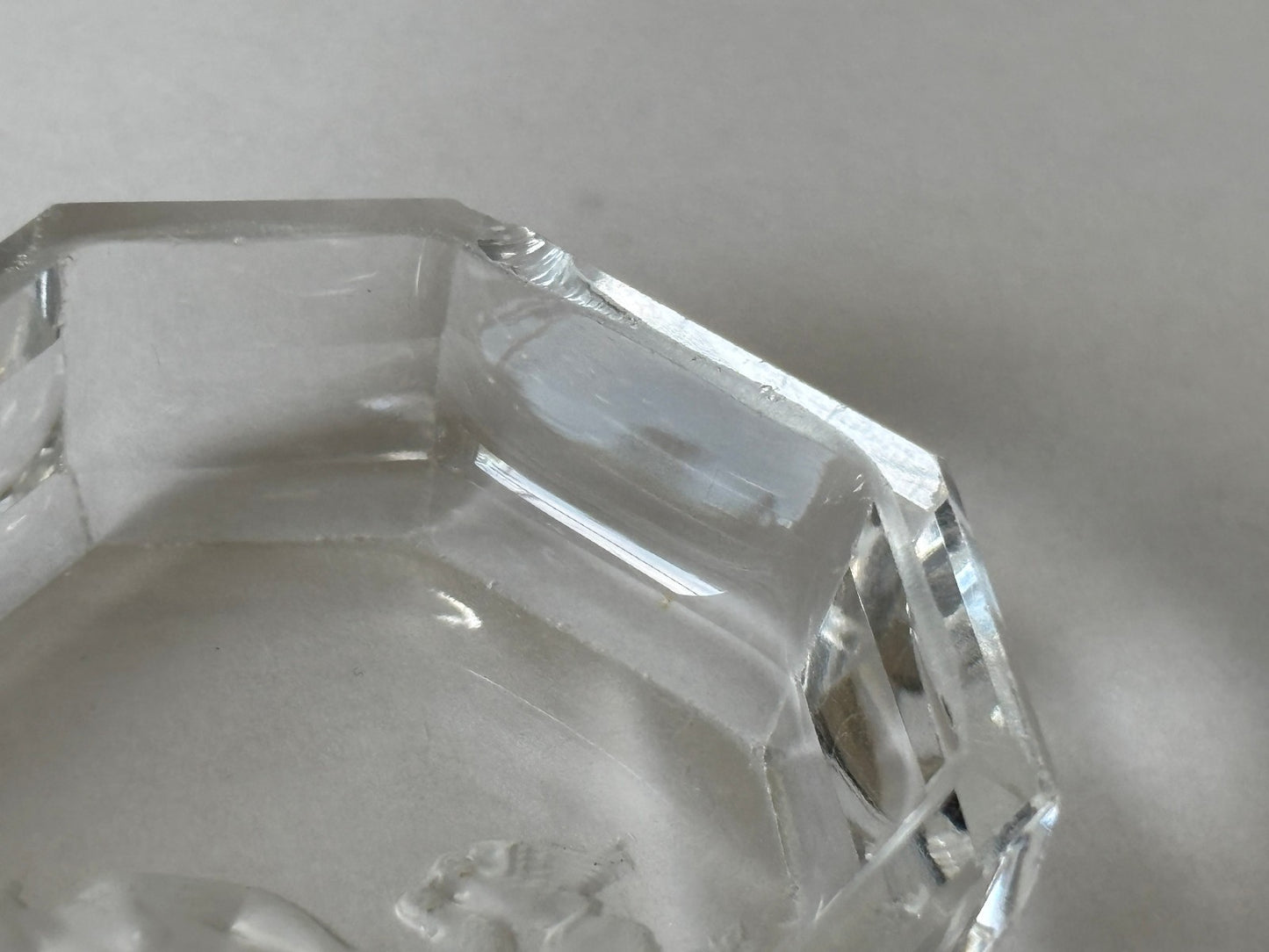
Set of 3, vintage 1920s, Art Deco style, intaglio Art Glass Pin or personal Ash Trays by Heinrich Hoffmann (see Notes below) with a central scene of a seated Venus with a cherub. These high quality, small, 8-sided cut corner rectangular crystal trays were probably vanity pin trays, salt cellars or personal ash trays. They were made by blowing the glass into molds and the accents were etched by hand on the bottom. The motifs show the goddess Venus seated in a garden with cupid and a pair of love birds. The quality of the crystal work for which Hoffman pieces are known, shows especially in the intricate details of the flowers and hair on the figures as well as the draping in the cloth of the clothing. These trays measure 2 3/4" wide, 2 1/8" deep and 3/4" high in the sides. The butterfly mark of Hoffman's crystal operations can be found on the lower right of each little tray. They are in good vintage condition, although some chips on the edges of each tray from use: one on top edge of one tray and small scratches and rough outer bottom edges - see detailed photos. A handsome and charming set of pin trays for a vanity, slat cellars for a dining table or ash trays for a bar, den or comfortable lounge area.
Free Domestic Shipping.
Notes:
Heinrich Hoffmann (1875-1939) was a prominent Czech glass designer in the early 20th century, known for luxury Art Deco and Art Nouveau-style vanity glass and decorative molded glass inspired by designers like Rene Lalique. The pieces were produced in Bohemia and largely sold in Paris. Hoffman was well known early for his Jet Black crystal as well as other innovative products. He also developed a technique to produce fine quality pressed and frosted glass with the appearance of cut glass, which was referred to as Intaglio cutting. In the late 1920s, Hoffman was part of the new surge in luxury glass production in Bohemia, producing architectural elements, lighting fixtures, perfume bottles and vanity pieces such as bowls, trays, glasses, etc., taking on an industry dominated by Venetian and French producers. Together with his colleague Henry Schlevogt (1904-1984), Hoffman produced his own designs as well as those of famed contemporary artists. This was also a time when perfume producers started to sell their scents in decorative bottles rather than selling the perfumes to be put into crystal bottles sold separately. With the opening of his first retail outlet, Max Factor contracted with Hoffman to design and make vanity items as well as the bottles for his new scent line, using the packaging as another luxury statement for his brand.